
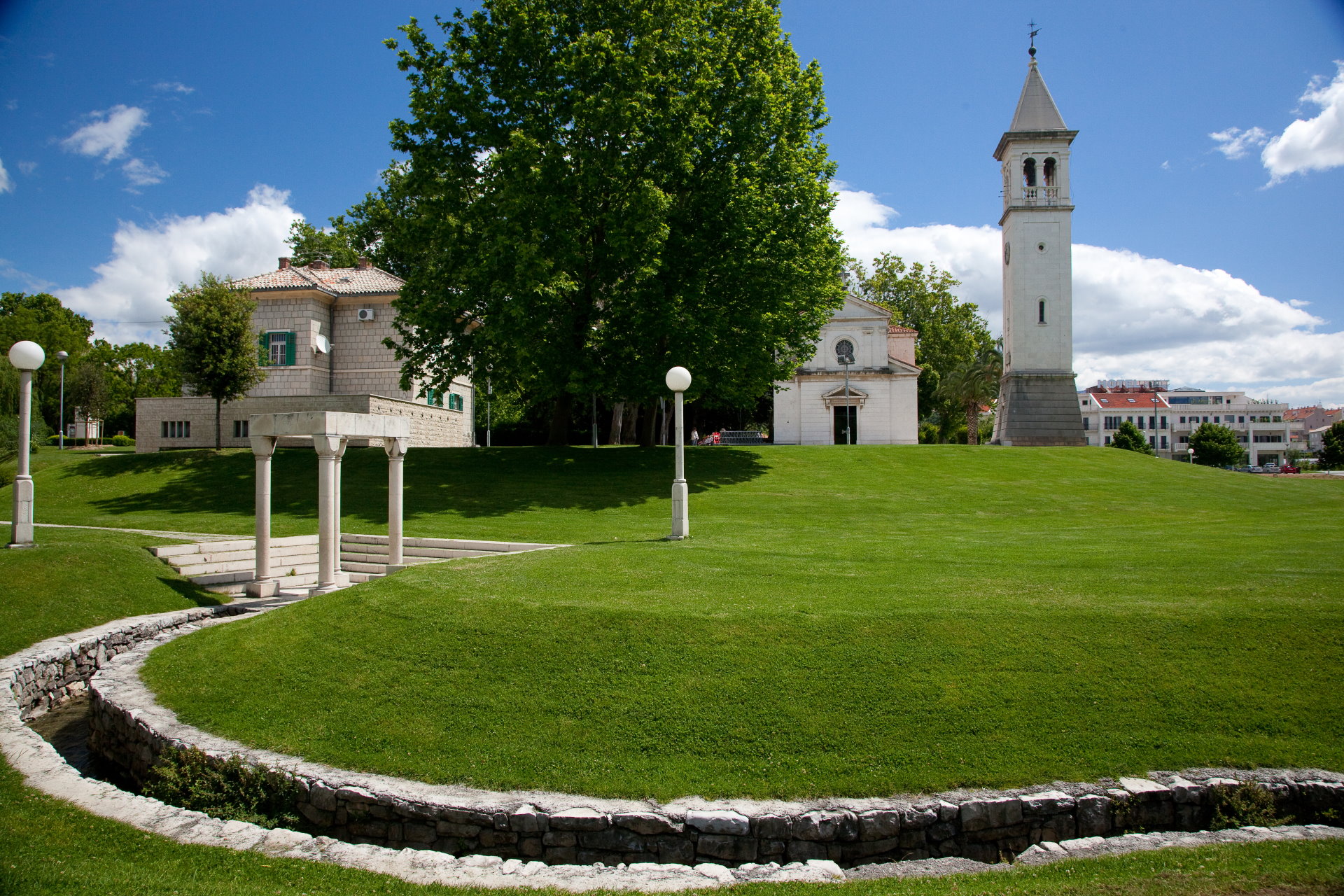


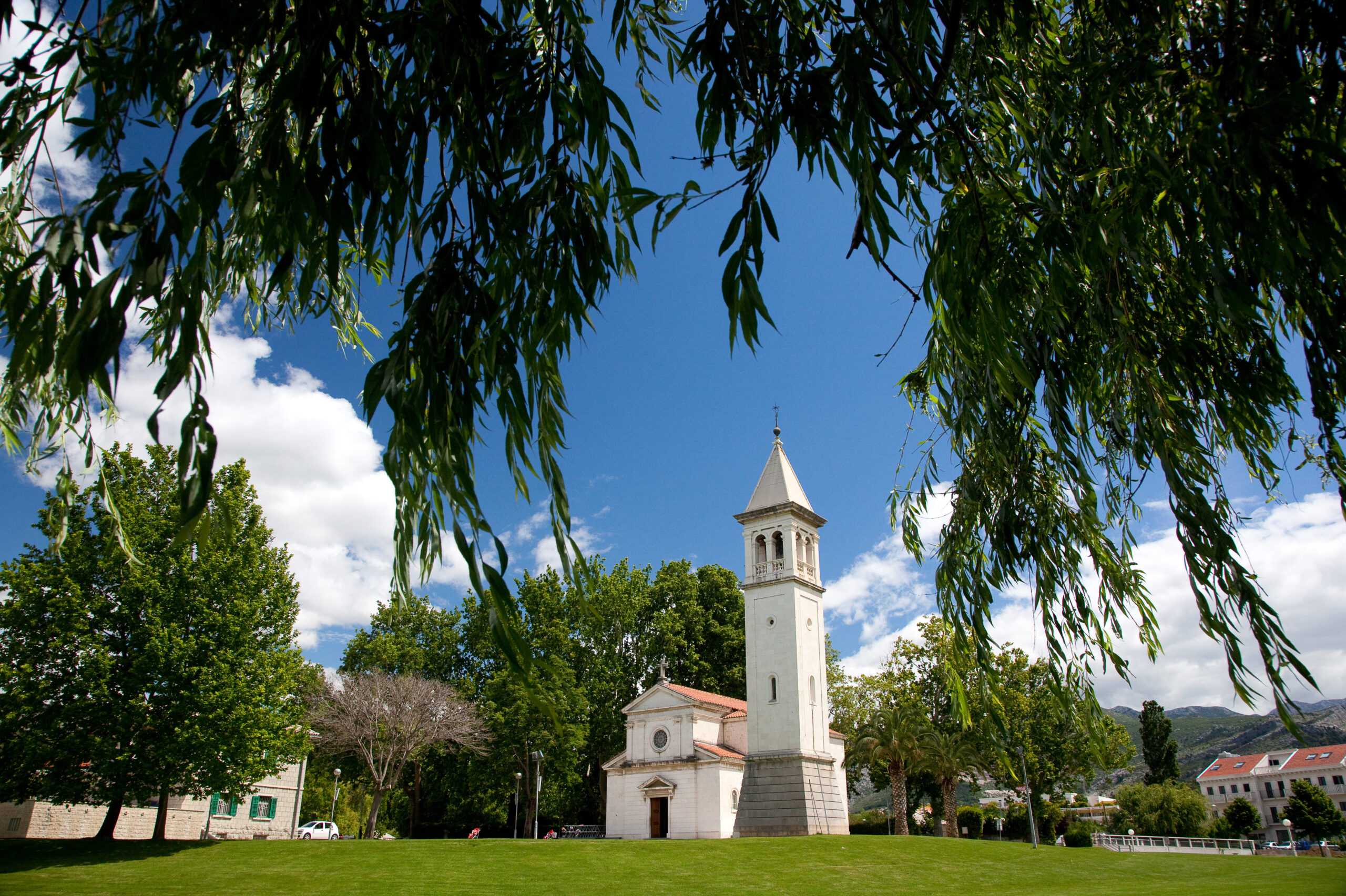


Our Lady’s Islet, the oldest Marian shrine in Croatia, surrounded by the backwaters of the Jadro River, became the first Croat settlement in the Middle Ages. On the Islet, in the 10th century, the site of the present-day church of St. Mary, Our Lady of the Island (1880), the Croatian Queen Jelena (Helena) built two churches, the Blessed Virgin Mary’s and St. Stephen’s church. In 1998 the shrine was visited by St. Pope John Paul II, sending a message to the citizens of Solin “Keep the treasure of faith that history has entrusted to you!”.
Next to the parish church dedicated to St. Mary, there is an extremely valuable archeological site, now whole underground. Along with the sanctuary, there is a landscaped lawn, which, with its simple horticultural style of landscaping, invites the citizens to coexist with this space, which echoes the children’s shouts of excitement, laughter of young people and the songs of believers from day to day. On the north side of today’s church of St. Mary, underground are the remains of a three_aisled church dedicated to St. Stephen. It was built, which is almost the rule in Solin, above Roman-era structures that extended to a larger island in the river delta. The discovery of a church on the Isle from ancient Croatian times and inscriptions carved on the sarcophagus of Croatian Queen Jelena happened, as is often the case, quite by accident. Namely, after the old church was burned down in 1875, a new, modern one was built in its place in 1880. When the foundations for the bell tower began to be dug in 1898, the remains of the old walls were discovered. This finding caught the attention of the then director of the Split Archaeological Museum, rev. Frane Bulić, who found them worth excavating.
Soon, in the church’s atrium, they found fragments of an inscription, one of them reading HEL. Bulić concluded they were fragments of the front side of a sarcophagus, all covered with an inscription. As the respected expert, he recalled the History of Salona by the Split’s chronicler, archdeacon Toma, where it was stated that the honourable man Dimitrije, also known as Zvonimir, the King od the Croats, restituted to Sv. Dujam’s (St. Domnio’s) Church (i.e., to the Archbishopric of Split) the churches of St. Stephan and St. Mary with all their properties.
These churches were built and donated by the Queen Helena, giving them to the Church of Split to hold them forever. Because of the adoration of some royal graves, they were temporarily given to some friars who celebrated masses in them. In St. Stephan Church’s atrium, there was buried the honourable man, King Krešimir, with many other kings and queens.