

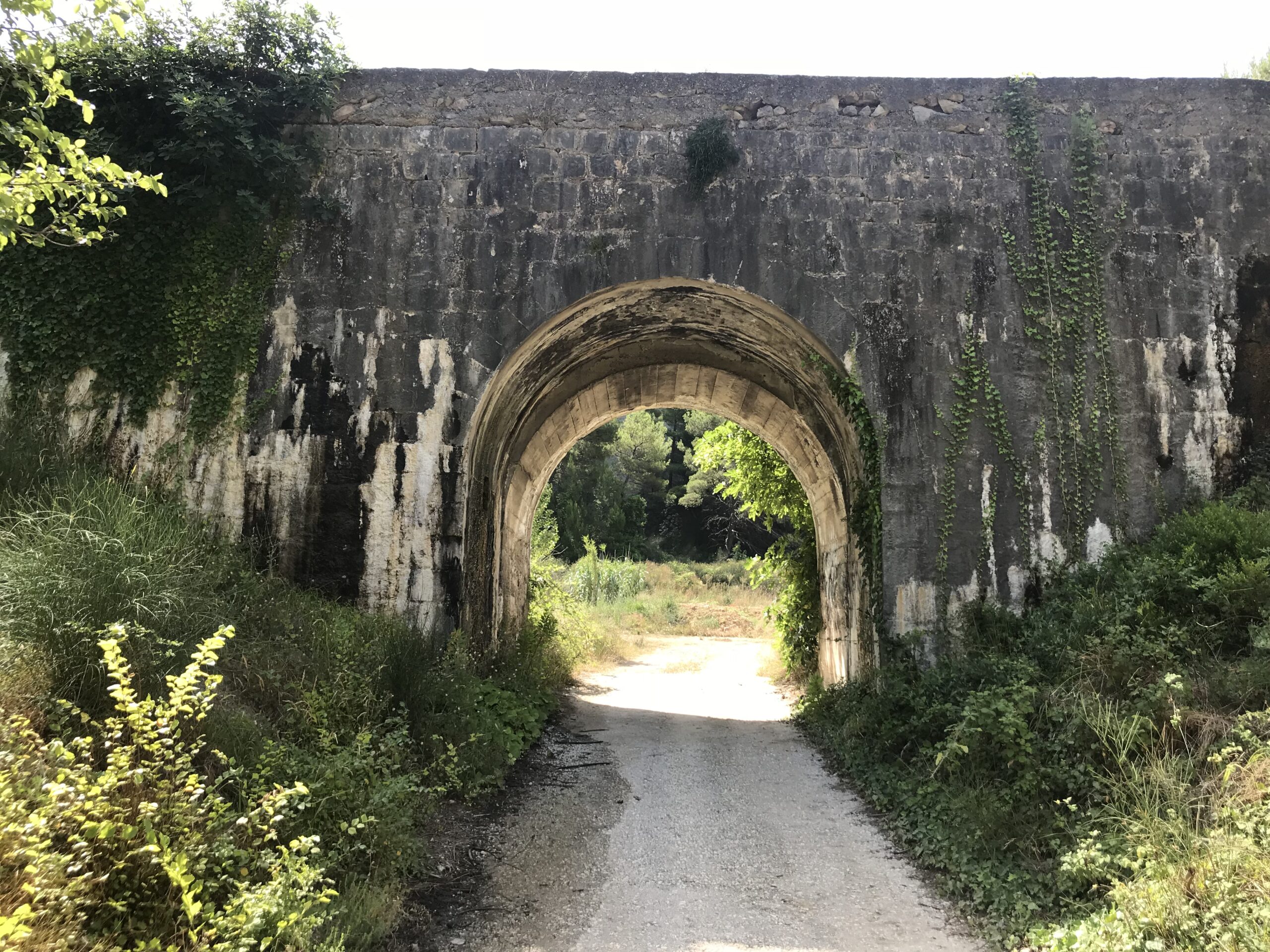


According to written sources, after abdicating in Nicomedia in May 305, the Roman emperor Diocletian settled in a palace he had built in the area of Aspalathos (present-day Split), not far from his native Salona. Comparing the construction of the Palace with other major construction works of the Roman Empire, it can be assumed that it lasted from 5 to 10 years. The construction of the aqueduct had to precede the construction of the Palace because of the water supply of the construction site, as well as the organization of lives of a large number of builders who worked on it, therefore, Diocletian aqueduct can be dated to the very end of third century. Due to the fact that it was reconstructed at the end of 19th century, it has been largely preserved, researched and documented.
The aqueduct extends 9 km in length from the source of the Jadro River, and used a free fall from the spring. It brought water to the Golden Gate of Diocletian’s Palace, from where it branched off into two ends for the purposes of the Palace. It provided 13 m³ of water per second, which was more than enough for the needs of residents. The geomorphological appearance of the terrain is different, so the shares of the aqueduct are different at different locations. Tunnels were dug through the hills, high gravity canal carriers into arcs were built over the valleys, and the largest tunnel was dug through Ravne njive neighbourhood (in Split), in the length of 1228 m.
The entire route of Diocletian’s aqueduct is today a protected cultural monument. It is in function from the source to the Ravne njive pumping station in the length of 5185 meters. Due to various construction and communal works, the original Diocletian’s canal was interrupted and demolished in Split in several places, but the builders always tried to reconstruct or bridge the destroyed parts. Recently, thanks to the efforts of the Conservation Department in Split, as part of the renovation of the various buildings on its route, aqueduct is being gradually explored and renovated.
In mid-July 2018, archaeological research were carried out on part of the restored Diocletian’s aqueduct in Majdan, near the Jadro River source. Around this part of the aqueduct, there was often the question of whether the arch on which the gravity canal was placed, was original or had been restored in the 19th century. No traces of the original arch were found during the research. The foundations of the arch were entirely created in the reconstruction from 1877 to 1880.
It is assumed that the area of Majdan and the source of the River Jadro were densely populated in the ancient times, with residential and commercial buildings as well as necropolises and burial grounds adjacent to roads or, later, sacral structures. The area of the source of the River Jadro was also interesting in the time of the migration of people, as we are told by a small but increasing number of newly discovered findings. One iron rail with a sill was found in the research, which indicates the great dynamics and excavation of raw materials during the industrial period of the first half of the 20th century. Through the surveys of old maps and photographs, their implementation and digitization, and placing them in today’s context and terrain, areas with high archeological potential have been identified, as shown by research carried out in 1993 and 2015. Future archaeological research and projects on the valorisation of cultural and natural heritage could reveal and bring to light a clearer picture of the past in this area.